
Hello there!
I am not used to publishing “long” articles… but I’ll give it a shot 🙂
Why? Well, I know we’ve all been there. You set a new goal, and maybe it’s learning a language, starting a fitness routine, or finally tackling that creative project. What’s great is that you’re filled with a powerful surge of motivation. The first week is amazing. The second is pretty good. But by week three, the initial excitement starts to fade, and the daily grind sets in. Suddenly, that epic goal feels less like an adventure and more like a chore.
What if there was a way to bottle that initial excitement and make it last? What if you could make the journey of self-improvement not just bearable, but genuinely fun and engaging?
This is the incredible promise of gamification. It’s a powerful, science-backed strategy that reframes your goals, turning them from a to-do list into an epic quest where you are the hero. Gamification is the strategic application of game design elements (points, levels, and quests, for example) into non-game contexts, like your personal and professional life. It’s not about playing more video games. Although I would love that, it’s about making your life as motivating and rewarding as a video game. That’s easier said than done, though.
Nevertheless, let’s explore the world of gamification and the brain science that makes it so effective. I will also share some tools that can help you.
Ready to press start? Let’s do this!
The “Magic” of Gamification (It’s Actually Brain Science!)
When you hear “gamification,” it might sound a bit like a trendy buzzword, but the reason it works so well is rooted in the fundamental wiring of our brains. This is our own psychology, not magic, and we can use it to our advantage. Just like in an accountability partnership, we’re leveraging proven principles to create lasting change.
The Dopamine Loop: Your Brain’s Built-in Reward System
Let’s talk about my favorite neurochemical superhero (or villain?): dopamine. Dopamine is a neurotransmitter in our brain that plays a huge role in motivation and pleasure. When you achieve something rewarding, such as eating a delicious meal, getting a compliment, or winning a game, your brain releases a little hit of dopamine, which makes you feel good.
Gamification is brilliant because it intentionally creates what experts call a “reward compulsion loop”. It works like this:
- You perform an action (e.g., complete a 10-minute meditation).
- You receive an immediate reward (e.g., you earn 10 XP and progress towards getting a “Mindfulness” badge).
- Your brain releases dopamine, giving you a feeling of satisfaction and accomplishment.
- Your brain then craves that feeling again, motivating you to repeat the action.
This simple loop is the neurological engine that turns small actions into consistent habits. Each time you check off a task, you’re reinforcing the neural pathways. Seeing your points go up makes that behavior easier to repeat in the future. Also, games and social media use the compulsion loop against us 😦 But I might talk about it in another post.
The Psychology of Play: Tapping into Human Nature
Beyond brain chemistry, gamification works because it taps into the fundamental human desires that games have leveraged for centuries: our innate needs for mastery, achievement, competition, social connection, and status.
One of the most powerful psychological principles at play here is the Zeigarnik Effect. This is our brain’s tendency to remember unfinished or interrupted tasks much better than completed ones. That’s also why we end up purchasing two or more of the same thing because we don’t remember we already got it, but I digress. Have you ever felt that nagging mental “itch” when you’re in the middle of a project? That’s the Zeigarnik Effect. Gamification tools like progress bars and daily streaks are masters at creating this itch. When you see a progress bar at 80% or a streak at 7 days, your brain craves the satisfaction and closure of getting it to 100% or making it to the next day. This creates a powerful pull to complete the task..
Intrinsic vs. Extrinsic Fuel: Finding the Right Balance for Lasting Motivation
To build a system that truly lasts, we need to understand the two types of fuel that drive us:
- Extrinsic Motivation: This is motivation that comes from the outside. It’s driven by external rewards like points, money, or even praise.
- Intrinsic Motivation: This is motivation that comes from within. It’s the drive to do something for its inherent satisfaction. For example, we find it interesting, challenging, or aligned with our sense of purpose.
Most gamification systems start by using extrinsic rewards (points and badges) to get you going. However, there’s a critical pitfall to be aware of: the “Overjustification Effect”. See, if you start giving someone an external reward for an activity they already enjoy, it can actually decrease their intrinsic motivation for that activity. They start doing it for the reward, not for the love of it.
This means a poorly designed gamification system, one that relies only on virtual loot, can be counterproductive in the long run. The ultimate goal of self-improvement is for new habits to become self-sustaining because they feel good and align with your values (intrinsic motivation). Therefore, the best gamification systems use extrinsic rewards as a temporary scaffold—a launchpad to help you build momentum. The true aim is to design an experience that fosters the three core psychological needs that fuel long-term, intrinsic motivation:
- Autonomy: The feeling of choice and control over your actions.
- Competence: The feeling of mastery and progress.
- Relatedness: The feeling of connection to others.
When your system supports these three needs, you’re not just chasing points; you’re building a deeply satisfying and sustainable practice.
You could design your system from scratch, using a spreadsheet to track your progress, assign points to completed tasks and give yourself badges if you attain X number of points, but you could also leverage on people who have created this already 😀
The Power of Shared Consequences
Some of the most effective gamified apps have mastered the art of social accountability.
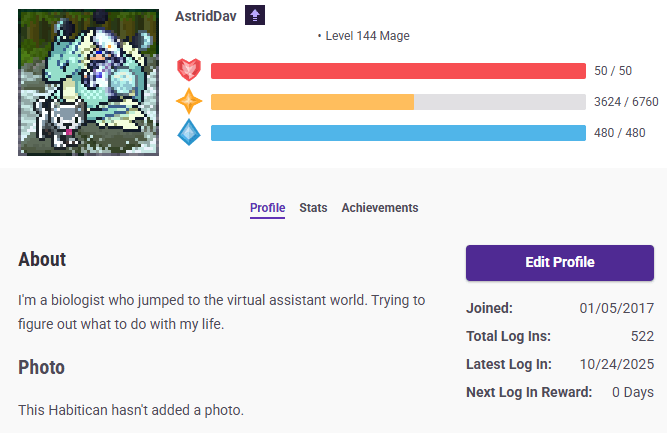
In the app Habitica, you can form a “Party” with friends to go on quests. If you fail to complete your daily tasks, your entire party takes damage from the monster you’re fighting. This creates a powerful sense of positive peer pressure. If you fail, you’re not just letting yourself down; you’re letting your team down. If you do your tasks and mark them as done, you damage the monster and earn points you can use to help yourself and your team.
There are other apps. For example, the focus app Forest has a “Plant Together” mode. You and your friends can start a focus session together. If one person gets distracted and leaves the app, everyone’s virtual trees wither and die. The stakes are suddenly much higher! Forest has plus as well, they plant real trees :’) I would also like to add that its main function is to act as a Pomodoro, and you can use it in solo mode too. I 100% recommend giving it a shot.
Conclusion: Press Start on a More Motivated You
Self-improvement doesn’t have to be a lonely, uphill battle. It can be an adventure, a game, a quest that you genuinely look forward to each day. Understanding more of how your brain is wired for motivation and applying the principles of game design can transform your entire journey.
Just in case, remember to start small with one specific behavior, choose the game mechanics that excite you the most, and consider bringing a friend along for a social quest. The goal is not perfection but progress that feels fun and rewarding.
You’ve already taken the most important step by deciding to invest in yourself (I mean, you invested time reading this article). You have the tools, and you understand more about the science behind it. So, what’s the first “quest” you’re going to add to your log? Share it in the comments below. Let’s do this together!
About the Author:
I’m Astrid, a biologist who made a career shift to become a virtual assistant and an accountability partner. My journey from the world of science to customer service and freelancing has given me a unique perspective on life, and I sometimes share it here on WordPress.
Do you need a capable and reliable accountability partner? Contact me on Fiverr or LinkedIn.
Latest posts
-

Accountability is more powerful than I thought
Something strange happened this month, and I honestly was not expecting it. Last year, I started working as an accountability partner, and yes, I have helped more than a dozen people to focus and work… Read more
-

The Science of Paying Attention: Why I Stopped Scribbling and Started Using Fathom AI
I remember sitting in a meeting with my thesis supervisor while we were planning our next steps. As she spoke, I lowered my head to scramble some annotations in my notebook. Suddenly, she stopped and… Read more
-

Why Guilt Kills our ADHDers’ To-Do Lists (And How to Fix It with Kindness)
Disclaimer: This article has situations that most ADHD-ers face, but not all sources used focus on neurospicy brains. Neurotypical brains might still face similar challenges, tho. Experiment with different approaches, but always prioritize professional medical… Read more


 Astrid Helps | Accountability partner | Biologist|
Leave a short reply here! This helps a small content creator.